
2026 Psychosis Care & Connection Retreat Videos


Recordings of the conference presentations are available below or on our YouTube channel.
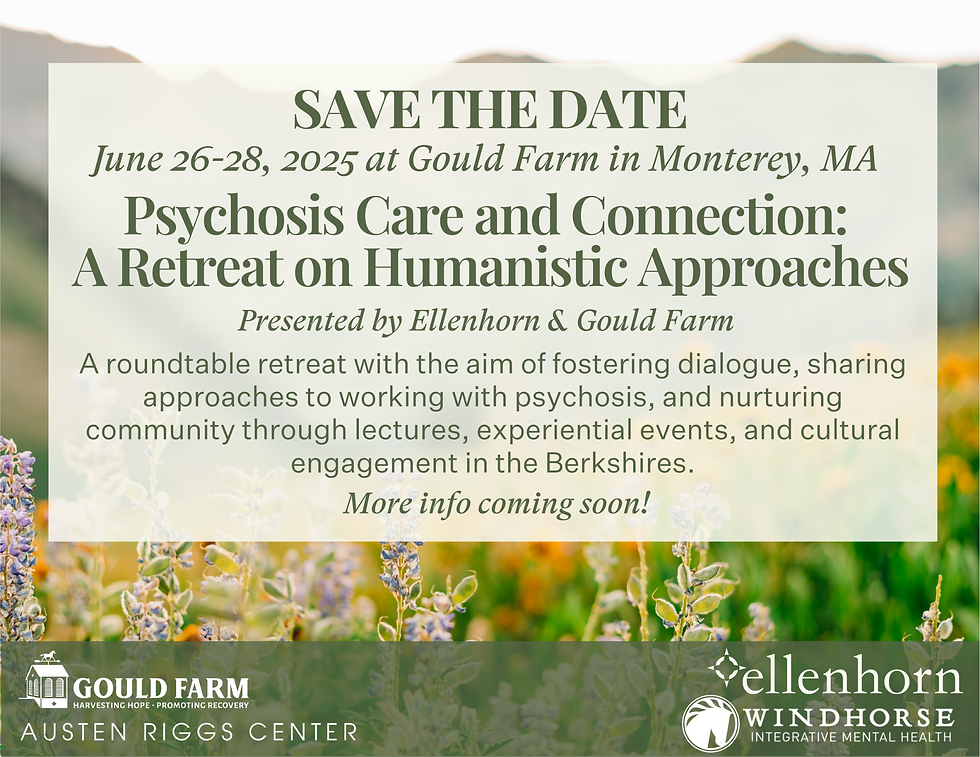
From June 25–27, 2026, Gould Farm co-hosted the third annual Psychosis Care & Connection: A Retreat on Humanistic Approaches, in collaboration with Ellenhorn and the Austen Riggs Center. Sponsored by a distinguished group of clinical partners – including McLean Hospital, Lakewood, Windhorse, Silver Hill, Bridge House, Help in the Home, Skyland Trail, Spring Lake Ranch, and Westbridge – the retreat convened practitioners from across the country dedicated to advancing care for adults experiencing severe mental illness, with a particular focus on psychosis.
Below are recordings of three of the five presentations given during the conference.
"Why Do Many Otherwise Well-Meaning Psychiatrists Often Fail to Appreciate The Psychological Dimension of Psychotic Suffering?" with Dr. Michael Garrett, MD.
Dr. Garrett addressed the persistent barriers therapists encounter when working through psychotic states, emphasizing the necessity of empathy, he said “Failure to appreciate the patient’s emotional concern, however fanciful it may be, communicates to the patient that the clinician isn’t paying attention or doesn’t really care.”
"Hospitality in the Psychotherapy for Psychosis," with Dr. Jeremy Ridenour, PsyD, ABPP.
Reflecting on biblical scenes of banquets and feasts, Dr. Ridenour explored what it means to truly welcome the stranger within the therapeutic encounter. Addressing the deep-seated stigma surrounding severe mental illness, he noted, “Madness is strange; fear makes the strange seem monstrous.” What does welcoming the strange and the stranger look like in a therapeutic context? Reframing traditional clinical dynamics, he offered a shift: the therapist not as the host generously receiving the patient, but a guest privileged with brief access to
the patient's inner world.
“Back to Basics: Listening for Islands of Clarity,” with Jay Smith, LICSW.
Drawing from contemplative psychotherapy, Smith outlined the practice of identifying fleeting "islands of clarity" – moments of insight that help build a "history of sanity" alongside the client, anchoring them in the slowly revealed, relational work of therapeutic encounters.
Smith quoted a compelling passage from the book Most of Us Recover: "A shift in allegiance isn’t like turning on a light switch. In the beginning of what’s often a gradual change, ambivalence often keeps us practicing our habitual self-deceptions. But once the truth of one's life becomes undeniable, revealing itself in disruptive islands of clarity, then it becomes impossible to ignore our deep health calling out."


Comments