
2026 Retreat Recap: Psychosis Care & Connection


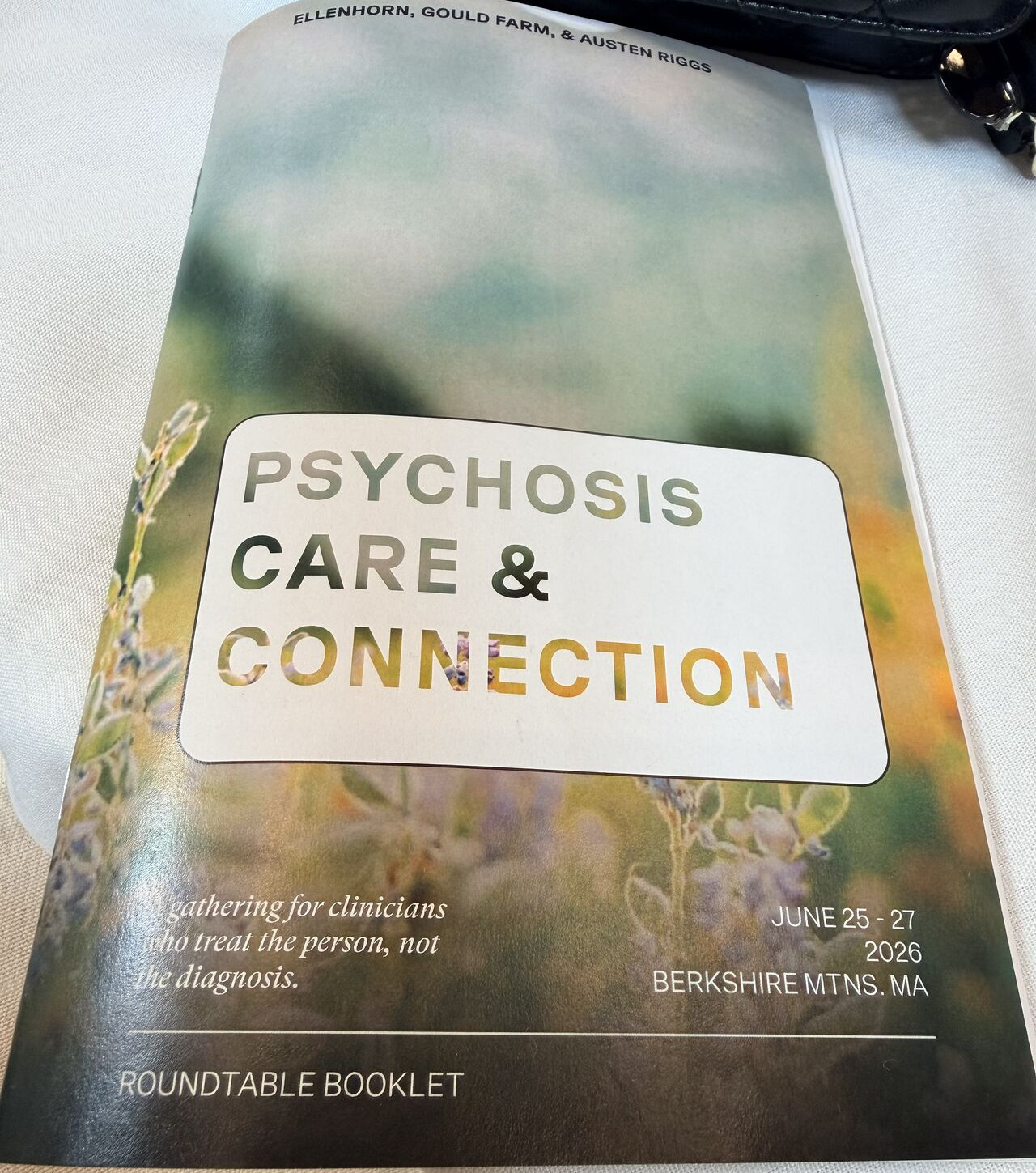
From June 25–27, 2026, Gould Farm co-hosted the third annual Psychosis Care & Connection: A Retreat on Humanistic Approaches, in collaboration with Ellenhorn and the Austen Riggs Center. Sponsored by a distinguished group of clinical partners – including McLean Hospital, Lakewood, Windhorse, Silver Hill, Bridge House, Help in the Home, Skyland Trail, Spring Lake Ranch, and Westbridge – the retreat convened practitioners from across the country dedicated to advancing care for adults experiencing severe mental illness, with a particular focus on psychosis.

The conference kicked off on Thursday with an open house at Windhorse in Northampton, MA followed by a welcome reception hosted by Austen Riggs Center in Stockbridge, MA. Then on Friday morning, as everyone convened for the start of the retreat at Gould Farm in Monterey, MA, Ross Ellenhorn gave a welcome talk that surveyed the history of mental health treatment and how many of the organizations present have played key roles in that history.
This introduction was followed by the first presentation, "Why Do Many Otherwise Well-Meaning Psychiatrists Often Fail to Appreciate The Psychological Dimension of Psychotic Suffering?" with Dr. Michael Garrett, MD.
Dr. Garrett addressed the persistent barriers therapists encounter when working through psychotic states, emphasizing the necessity of empathy:
“Failure to appreciate the patient’s emotional concern, however fanciful it may be, communicates to the patient that the clinician isn’t paying attention or doesn’t really care.”
You can watch his entire presentation here:
Next there was an informative presentation with Hilary Kaul, DSW, LICSW, titled "Refocusing on Family Burden in Schizophrenia Care: Time-Limited In-Home Family Support Model". (That video is not available due to confidentiality of the case studies mentioned during the presentation.)
Following an relaxing outdoor lunch in beautiful June sunshine, attendees gathered for the Lived Experience Panel – facilitated by Stacey Henson, LCSW, ACSW, clinical outreach director at Gould Farm. This Panel, according to feedback from attendees, was the highlight of the retreat. The panel included a former guest of Gould Farm, a family partner from Ellenhorn, and a staff member of Riggs. Their experiences and personal reflections touched people deeply.
The panel was then followed by afternoon roundtables to synthesize clinical insights from the day. The day concluded with a Roadside Store & Cafe pop-up and sponsor-led dinners in town.
On Saturday, the retreat moved to the peaceful grounds of Austen Riggs Center in nearby Stockbridge. After breakfast, the day began with "Hospitality in the Psychotherapy for Psychosis," a presentation with Dr. Jeremy Ridenour, PsyD, ABPP.
Reflecting on biblical scenes of banquets and feasts, Dr. Ridenour explored what it means to truly welcome the stranger within the therapeutic encounter. Then addressing the deep-seated stigma surrounding severe mental illness, he noted, “Madness is strange; fear makes the strange seem monstrous.” What does welcoming the strange and the stranger look like in a therapeutic context? Reframing traditional clinical dynamics, he offered a compelling shift: the therapist not as the host generously receiving the patient, but a guest privileged with brief access to the patient's inner world.
You can watch his entire presentation here:
Next on the schedule was "Thinking Beyond Diagnosis: The Role of Spirituality and the Arts in Treatment of Severe Mental Illness", a presentation with Dr. Jeffrey Katzman, MD. (This talk could not be shared publicly because it mentioned confidential case studies.)
Later in the afternoon, Jay Smith, LICSW presented “Back to Basics: Listening for Islands of Clarity.” Drawing from contemplative psychotherapy, Smith outlined the practice of identifying fleeting "islands of clarity" – moments of insight that help build a "history of sanity" alongside the client, anchoring them in the slowly revealed, relational work of therapeutic encounters.
Smith quoted a compelling passage from the book Most of Us Recover:
"A shift in allegiance isn’t like turning on a light switch. In the beginning of what’s often a gradual change, ambivalence often keeps us practicing our habitual self-deceptions. But once the truth of one's life becomes undeniable, revealing itself in disruptive islands of clarity, then it becomes impossible to ignore our deep health calling out."
You can watch their entire presentation here:
As the gathering drew to a close, the shift away from clinical distance toward genuine human connection remained the central takeaway. In a post-conference reflection, attendees Stacey and Rayetta from Help in the Home captured the spirit of the weekend:
...the through-line of the whole weekend was connection. Not treatment plans, not diagnoses, [but] connection. We expected good sessions and useful conversation with peers in the field. What we didn’t expect was how much the retreat would feel less like a professional event and more like a personal one, and that gap between expectation and outcome turned out to be the best part of the weekend…
One of the most powerful parts of the weekend was a panel featuring Bob, who lives with schizophrenia. Bob talked about what it meant to work side by side with staff [when he was a guest] at Gould Farm, with no label separating them.
When you remove the invisible wall between “the people who help” and “the people being helped,” something shifts. People find purpose. They find dignity. They find their way back into a life.
The retreat concluded with a BBQ at the Red Lion Inn, hosted by Ellenhorn, offering time to socialize and reflect on a weekend defined less by institutional protocols and more by authentic human encounter.
We hope to see you when we host the retreat again next year!


Comments